The short answer
- A subfloor has to be flat, dry, clean and solid before any new floor goes down.
- Flatness depends on the install method: about ¼″ in 10 ft for nail-down hardwood, and 3/16″ in 10 ft for glue-down floors and most floating LVP and laminate.
- Hardwood needs a moisture test of both the subfloor and the wood. Concrete follows the flooring and adhesive manufacturer's rules.
- Light prep is part of our install. Bigger fixes are priced separately, like self-leveler at about $90 per bag and concrete sealing at about $2 per sq ft.
Most flooring problems we're called to fix, like squeaks, gaps, popped click joints or planks that flex underfoot, started with the subfloor. A beautiful floor installed over a bad base won't stay beautiful for long.
We're Vision Flooring in Everett, WA. After more than 20 years in construction, subfloor prep is the part of the job we're most careful about. Here's how we do it, and what you should expect from any flooring contractor.
What does subfloor preparation involve?
Getting the subfloor flat, dry, clean and solid. Every flooring type needs all four. How strict each one is depends on the floor and the installation method.
Flat
No dips or humps beyond the floor's tolerance. Thin floors "telegraph" bumps, and uneven spots can break click joints.
Dry
Moisture levels within the flooring manufacturer's limits. For hardwood, the subfloor and the wood need to be close to each other.
Clean
Old adhesive, staples, tack strip, paint drips and debris removed. Anything left behind becomes a bump or a squeak.
Solid
No loose panels, soft spots or water-damaged plywood. The subfloor shouldn't flex or move when you walk on it.
How flat does a subfloor need to be?
For nail-down hardwood, the National Wood Flooring Association standard is ¼″ in 10 ft (or 3/16″ in 6 ft). Glue-down floors need 3/16″ in 10 ft (or 1/8″ in 6 ft). Most floating LVP and laminate products ask for about 3/16″ in 10 ft, but always check your product's installation instructions.
To check, lay a long straightedge or level across the floor in several directions and measure the biggest gap underneath it. Mark the low spots and high spots with a pencil.
How do you level a plywood subfloor?
Sand down the high spots and fill the low spots. On plywood, the usual high spots are panel seams that have swelled or peaked. We sand them flat. Low spots get a floor patch compound, feathered out and sanded smooth once it's dry.
- Peaked seams: sanded flat. Light seam sanding is included in our installation price.
- Dips: filled with patch and feathered out.
- Squeaks and loose panels: screwed down into the floor joists.
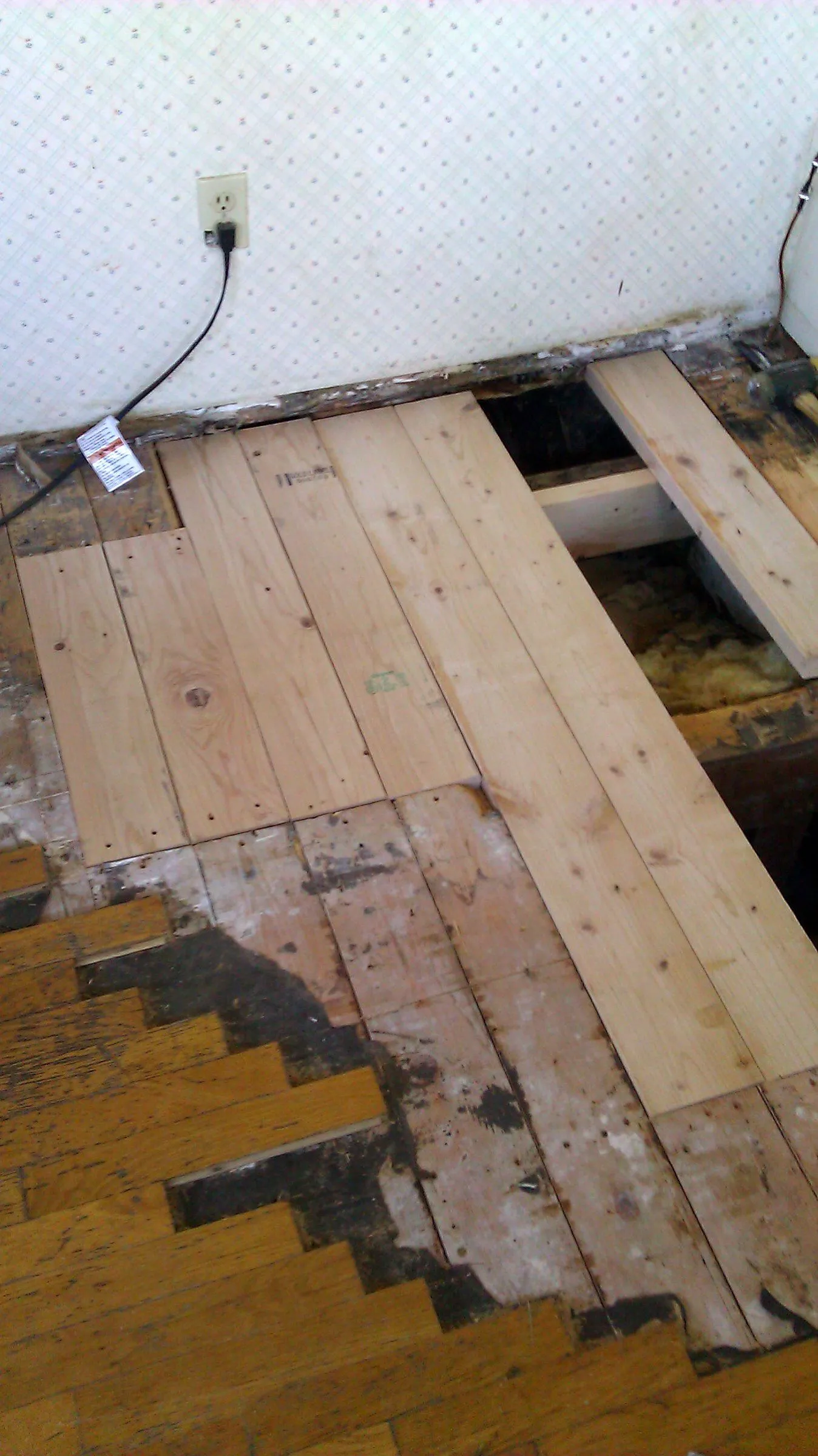
- Soft, delaminated or water-damaged plywood: cut out and replaced. This is a subfloor repair, priced separately.
How do you level a concrete subfloor?
Grind the high spots and pour self-leveling compound in the low areas. Self-leveler is mixed and poured over a primed slab, where it flows out into a flat, smooth surface. We price it at about $90 per bag, including material and labor. Leveling a few low spots in a kitchen might take 3–5 bags, or about $270–$450.
Most self-leveling work adds about one day for drying, and many pours are dry overnight. Actual drying time depends on the product, thickness, temperature and humidity, and we always follow the manufacturer's instructions before the floor goes down.
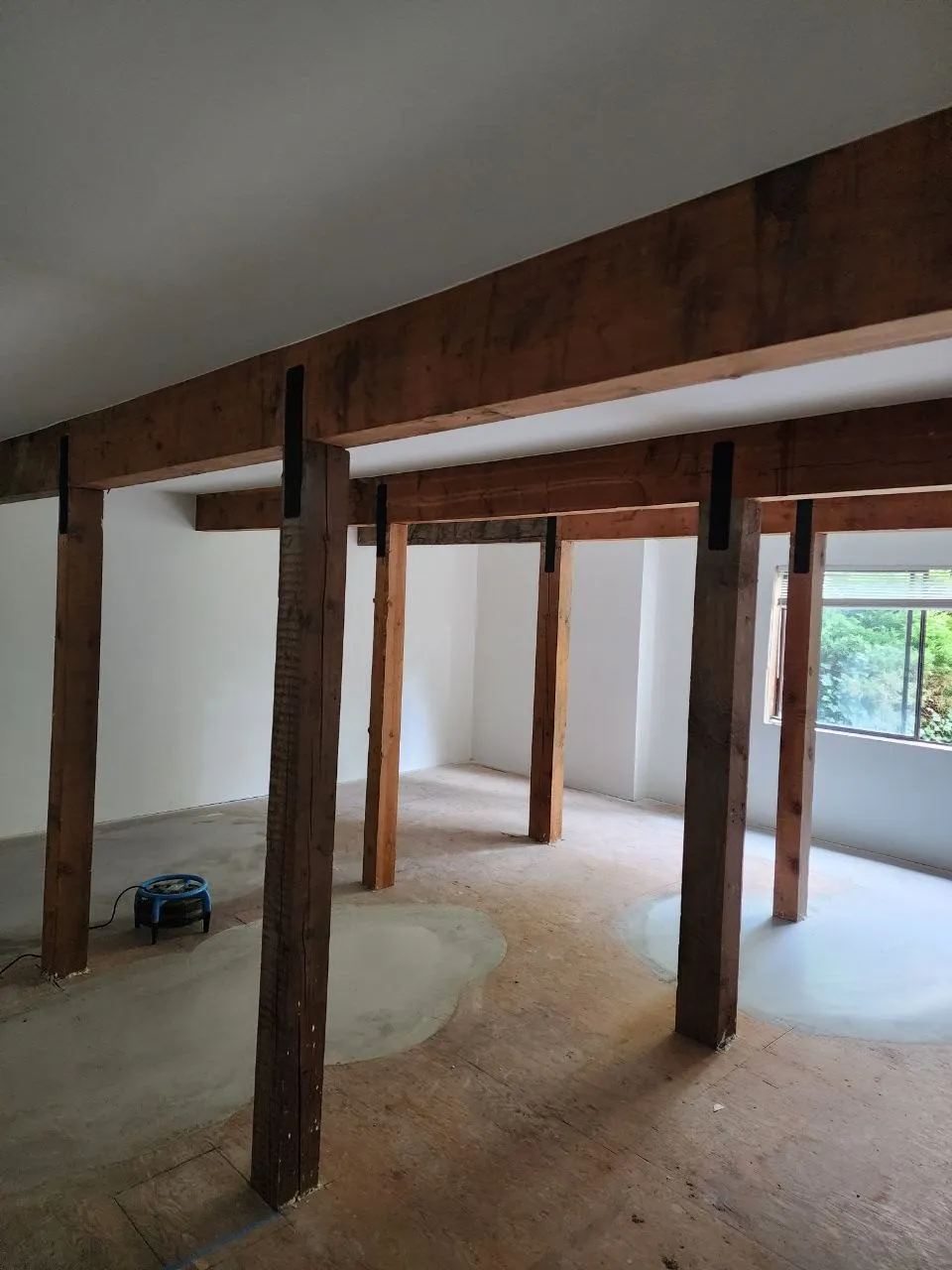
Does a subfloor need a moisture test?
For hardwood, always. We measure the moisture content of both the plywood subfloor and the hardwood before installation. Our standard is that the two stay within 5 percentage points of each other, for example 8% and 13%. Some manufacturers require an even closer match, and their rules come first.
Concrete is tested the way the flooring and adhesive manufacturers require. That's especially true for glue-down floors, because adhesives have strict moisture limits. LVP handles everyday moisture well, so routine moisture testing isn't usually needed unless the product or adhesive calls for it.
Why acclimation matters tooHardwood and laminate are delivered to your home 3–5 days before installation to adjust to the indoor conditions. That has to happen inside the living space, not the garage. LVP usually doesn't need an acclimation period.
Does concrete need to be sealed before new flooring?
For laminate, yes. Every time. Laminate is moisture-sensitive, so we seal concrete before every laminate installation. For LVP and hardwood, sealing is required only when the flooring manufacturer calls for it. Concrete sealing runs about $2 per sq ft, including sealer and labor. A 500 sq ft basement comes to about $1,000.
Can new flooring go over my existing floor?
Sometimes. It has to be hard, flat and solid. Here's how the common situations usually work out:
- Carpet: never. Carpet always comes out first.
- Tile: LVP and laminate can often go over solid, flat tile. Deep grout lines may need filling first.
- Sheet vinyl: often removed, especially if it's loose or sits on particle board. Removal including particle board runs about $4 per sq ft.
- Existing hardwood: new hardwood over old is evaluated case by case. Sometimes it works, and sometimes the old floor has to come out.
Removal costs vary by material. Carpet is about $0.75–$1 per sq ft, click laminate or LVP about $2, hardwood about $3 and tile about $8–$15.

Do I need underlayment over the subfloor?
It depends on the floor. If your LVP or laminate has an attached pad, it goes straight onto the prepared subfloor, with no second pad. Laminate always needs a pad, either attached or a separate roll. Nail-down hardwood goes over vapor-retarder paper, which is included in our nail-down price. Read more in does hardwood flooring require underlayment?
What's included in subfloor prep, and what costs extra?
Light prep is part of our installation. Bigger fixes are listed separately on your estimate, so you can see exactly what each one costs.
- Included: light sanding of plywood seams and minor surface prep
- Self-leveling compound: about $90 per bag, material and labor
- Concrete sealing: about $2 per sq ft, when required
- Major leveling or subfloor repairs: quoted for your specific floor
- Removing the old floor: priced by material, as listed above
If we find a hidden problem after the old floor comes up, like rot or a soft spot, we'll show you and explain the fix before doing any extra work.
Can I prep the subfloor myself?
Some of it. Pulling carpet, tack strip and staples, scraping off loose debris and vacuuming are good DIY jobs that can save you money. Leveling, self-leveling pours, moisture testing and subfloor repairs are worth leaving to a pro, because mistakes there show up in the finished floor. Tell us at your estimate what you plan to do yourself, and we'll check it before installation starts.
Prep done right, the first time
Two decades of construction taught us that what's under the floor decides how long the floor lasts.
20+ yearsin construction and remodeling
Moisture testedsubfloor and hardwood before every hardwood install
Clear pricingevery prep item listed separately on your estimate
1-yearLimited Workmanship Warranty on our work